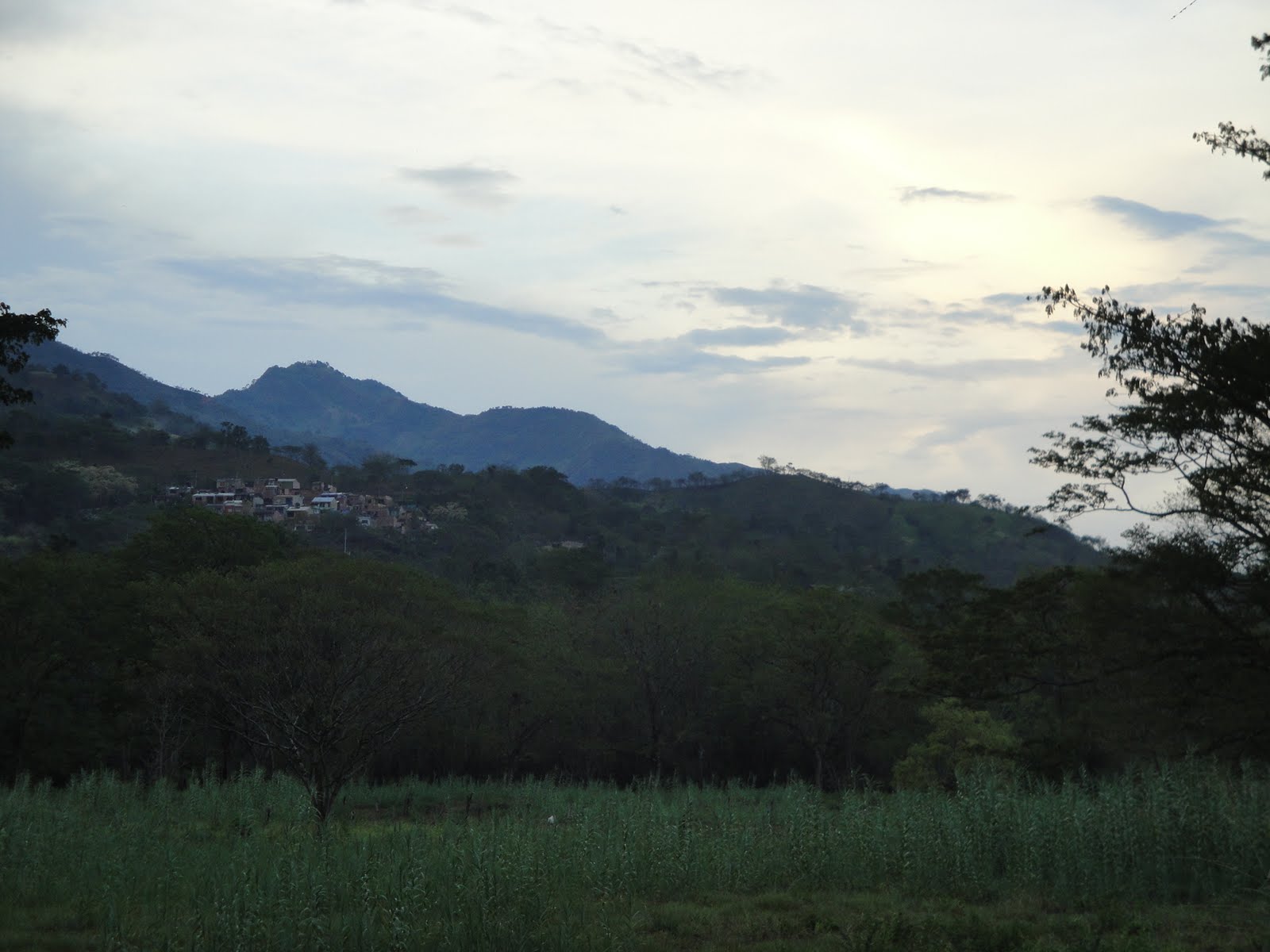
The photo of Providencia, with the well-known Split Hill or Loma Partida in the background, was taken from the smaller island of Santa Catalina, which is connected to Providencia by a small floating bridge for pedestrians. Speaking of Santa Catalina, biologist Germán Márquez Calle notes in the booklet A Guide to the Environment of Old Providence and Santa Catalina (a gift from Javier Archbold Hawkins, one of my gracious hosts on this trip) that there is a striking resemblance between Providencia and the map of the fictional island from Robert Louis Stevenson's famous novel "Treasure Island," in that the map of the island in Stevenson's novel includes a small island with roughly the same proportions to the larger island as Santa Catalina has to Providencia. Though the association between the real island and the fictional one has not been proven conclusively, to my knowledge, it's still fun to speculate. What we do know about Providencia is that pirates did inhabit the island at certain times in its history, most notably Henry Morgan, who used Providencia as a base to invade Panama and other Spanish possessions. Looking at certain parts of the island, you definitely can imagine a pirate movie being filmed there.
Wednesday, September 22, 2010
Back in Providencia, Colombia (2010)
Labels:
Colombia,
Latin and Caribbean travel site,
Providencia,
tourism,
travel,
vacation
Saturday, June 12, 2010
Captured by pirates?
Am I on my way to being abducted by a rascally pirate? Not exactly. We just made a stop at the Pirates of Nassau Museum on our vacation to the Bahamas last month. This was one of the highlights of our vacation for the kids. The history of pirates is fascinating, and it's evident when you visit the museum that a lot of care went into the development of the exhibits. It's also not so large that kids would wind up being bored. This colorful character greeted you at the entrance and at the exit, and of course spoke what we could consider to be typical pirate language (no "Arrr's" though).
Pirates covered a large area of the seas during their heyday, and you'll find museums and exhibits dedicated to them in quite a few places. Some years ago, when we stopped at the town of Bath on our way to the Outer Banks in North Carolina, we saw an exhibit on Blackbeard, who was captured and executed in that area. We ran into stories of pirates when we went to Cartagena, Colombia as well, because Sir Francis Drake attacked the city at one juncture.
See my webpage on the Bahamas for more pictures and information.
Pirates covered a large area of the seas during their heyday, and you'll find museums and exhibits dedicated to them in quite a few places. Some years ago, when we stopped at the town of Bath on our way to the Outer Banks in North Carolina, we saw an exhibit on Blackbeard, who was captured and executed in that area. We ran into stories of pirates when we went to Cartagena, Colombia as well, because Sir Francis Drake attacked the city at one juncture.
See my webpage on the Bahamas for more pictures and information.
Labels:
Bahamas,
Bath,
Blackbeard,
Caribbean,
Nassau,
North Carolina,
Pirates of Nassau Museum,
travel,
vacation
Friday, March 19, 2010
Waiting for those elusive white birds in Villeta, Colombia
Last year our extended family spent a weekend in Villeta, a town not far from Colombia' s capital city of Bogotá, a favorite resort spot along with Melgar and Girardot because of its warmer climate. During the weekend, I became fascinated with the flora and fauna of the area, and it seemed that there was a surprise at every turn: a flower here, an interesting insect there, a tree with unusual seeds or another plant growing on one of its branches, and birds of all sizes and shapes. Colombia is supposed to have more species of birds than any other country in the world. In the lower elevations where the climate is warmer, the way that the birds seem to fly in carefree fashion gives the impression that they are in their own version of paradise, where it never gets cold and there appears to be more than enough for them to eat. (Of course, drought can be a problem at times.)
There were birds that were easy to observe, such as these swallows who had made a nest in the house we were staying in. Other birds were content to find food or water near the swimming pool. Another bird allowed itself to be photographed in dramatic fashion against the mountain backdrop.
Sunset in particular is a great time to observe birds. There are plenty of them flying around, either by themselves or in flocks, and one need do no more than to sit out on the patio and watch. During our weekend, my sister-in-law called my attention to one type of bird that I had seen on many occasions but never thought about consciously. She said that every evening, a flock of large white birds would fly across the sky in full view, with the mountains in the background, but you would see them only once each evening. Once, while I was looking at pictures stored on my digital camera, she said, "Look! There they are!" and of course, by the time I looked up to see, they were already gone. This last picture represents my attempt to capture the sky at sunset, in the direction they were flying. One day maybe, when I'm ready, I'll be able to capture their flight in a picture or a video clip!Wednesday, February 17, 2010
Guasca, Colombia and its beautiful church
The Colombian town of Guasca is a hidden gem. It's situated a little higher than the towns that surround it on the northern outskirts of Bogotá. It's not on the main road and you have to drive out of the way to get there, fortunately only about 2 kilometers. If you leave Bogotá by the mountain road that goes toward La Calera and continue on as if you were going to Guatavita, you can turn off where the sign indicates Guasca. When we went, we didn't stay long, just enough to take in the pretty views that were the result of this city being on a small hill above the others. Also noteworthy was the church that occupied a prominent place in the plaza, especially as the whole plaza was sloped uphill and the church sat at the top. I just loved the interior of this church, which looked very well maintained.
Monday, February 1, 2010
The Joys of the "Almuerzo Típico"
I am always blown away by the large portions of food that I get when I travel in Colombia. This is what you would call an "almuerzo típico" (literally translated "typical lunch"). Aside from the steak, beans, plantain chips, rice, potato, tomatoes, and blackberry juice ("jugo de mora") pictured here, the meal starts out with a soup of the day. The soup could be, for example, a pasta soup or a broth with some meat and potatoes mixed in. All this together sold for $2.25!In Colombia itself, the almuerzo típico sometimes suffers from an image problem. Often - and I found this out very early in my travels there - some of the locals, judging by the crowds, seem to prefer eating at a hamburger place because of its suggestion of an American eating experience, and usually pay more for what I think is inferior food. It may be human nature to prefer those products that seem out of the ordinary even when they aren't better than one's own.
There is at least one exception to this rule, however. Colombians, and people from many other parts of the world as well, don't like to rush their meals unless they're absolutely forced to. I recall that when some of my in-laws came up from Colombia and visited New York with us, the biggest culture shock for them was something I never would have imagined. It happened when we were driving through Manhattan and we saw a man standing on the sidewalk eating a hamburger. They were absolutely astonished to see him finish it in five bites!
Wednesday, December 23, 2009
The Nativity novena in Colombia
On December 16, many families in Colombia, and Colombians living outside of Colombia, begin praying the Nativity novena ("Novena de Navidad"), a nine-day series of prayers designed to prepare for the arrival of the baby Jesus on the night of December 24. The novena is definitely one of my favorite Colombian traditions.It's worthwhile to point out that in Latin America, Christmas is not considered to be celebrated on the day of December 25, but rather the night of December 24 or "noche buena" (literally, "good night"). It's a subtle difference but important nonetheless.
The novena contains a series of prayers recited every evening. They include daily prayers to the Virgin Mary, St. Joseph, and the Christ Child, a series of poems of praise called the "gozos" that can be either recited or sung, along with a separate prayer specific to each day of the novena called the "consideración" that highlights an aspect of Mary and Joseph's journey to Bethlehem and the events that surrounded the birth of Jesus.
There is what you could call a quaint Catholic spirituality around these prayers. Many of the thoughts around using Christ's humility as a model for our own lives are worthwhile to contemplate. Occasionally, though, the reflections border on an absurdity particular to old-style Catholicism, such as in the prayer on the eighth day recounting how Mary and Joseph could not find a place to stay in Bethlehem: "The sound of each door that closed on them was a sweet melody for their ears." ("El ruido de cada puerta que se cerraba ante ellos era una dulce melodía para sus oídos.") Also, the prayer to St. Joseph can cause some chuckles because he is referred to as the "padre putativo de Jesús" (adoptive father of Jesus), where "putativo" sounds too close to a Spanish curse word. Nowadays the offending word is often replaced by "adoptivo."
Following the novena, the family will often sing traditional Spanish Christmas carols or "villancicos," either playing the instruments themselves or singing along to a CD. In some cases the novena becomes a social event for inviting extended family members, with food and drink served after the prayers are recited.
Labels:
Christmas,
Christmas carols,
Colombia,
Nativity,
noche buena,
novena,
villancico
Thursday, October 22, 2009
The Garífuna community pays a visit to Philadelphia in August 2009
To summarize, the Garífuna are descendants of a mixture of Africans and Carib peoples, the majority of whom settled on the Caribbean island of St. Vincent until they were forced out by the British at the end of the 18th century. Those set adrift on a ship by the British from St. Vincent, on the eastern side of the Caribbean Sea, landed providentially on the island of Roatán on the western side. Today Roatán belongs to the Central American nation of Honduras. The Garífuna eventually migrated to the mainland and settled on the Caribbean shores of Honduras, Guatemala and Belize. Many descendants of those migrants later moved to New York, specifically Brooklyn, where they form a thriving community.
Garífuna music and dance, with its combination of African and Native American traits, does not sound exactly like other African forms of music in the Caribbean region. In particular the singing style and the drum patterns make it unmistakable. Some people may be familiar with the punta rhythm, which can be played traditionally or in the modern "punta rock" style. There are also Garífuna rhythms such as the "paranda" that use the guitar, which suggest influence from Spanish music. Garífuna culture is familiar enough for you to find explanations on the Internet or examples on YouTube.
Subscribe to:
Posts (Atom)